What changed
Three things changed simultaneously between 2022 and 2025. First, the manufacturing partners that supply contractor-installed carports began exporting kit-format versions of the same structural specifications directly to consumers. Same gauge of galvanized steel. Same wind ratings. Same anchoring system. The kit is essentially the contractor product, minus the contractor.
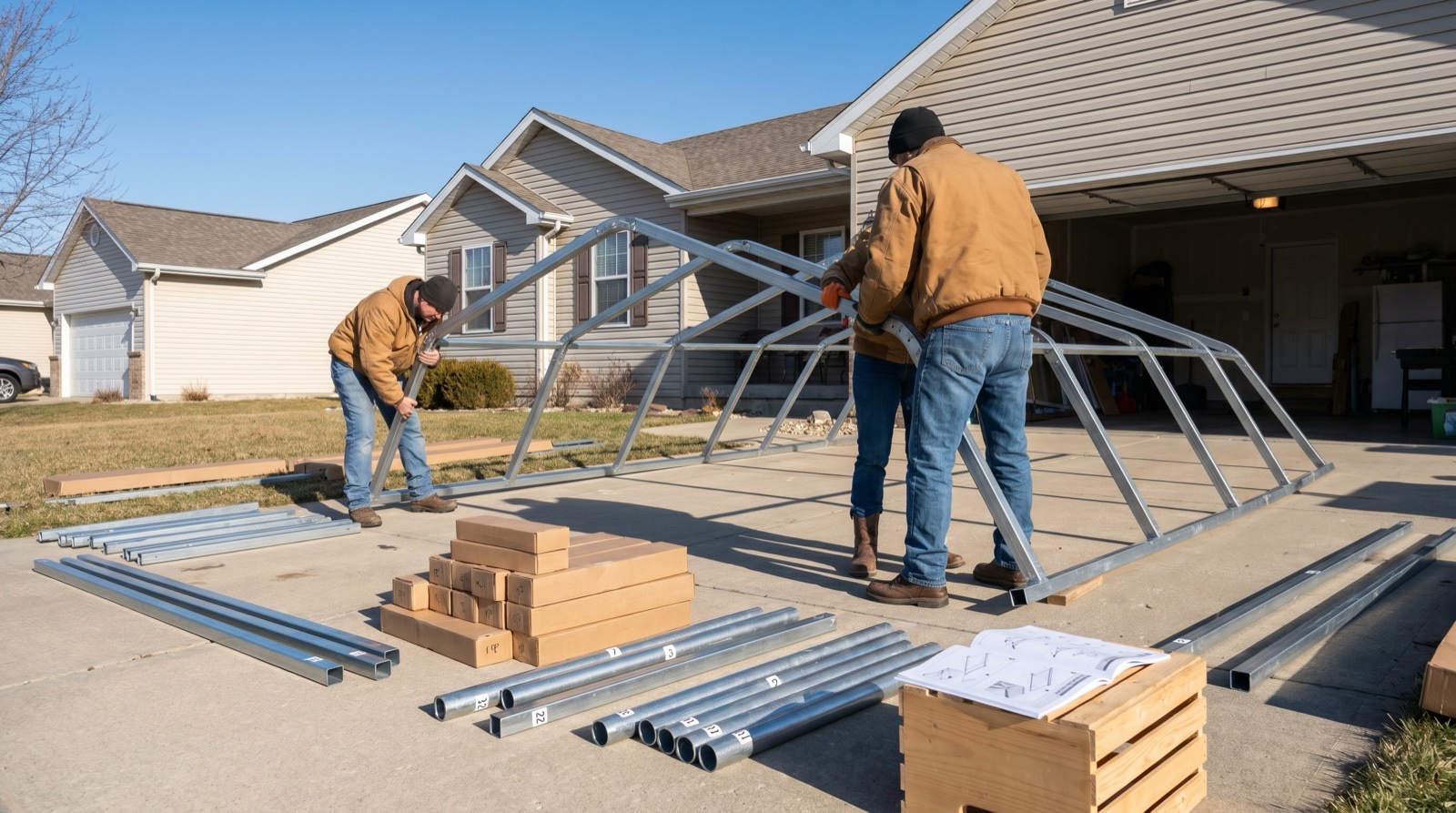
Second, instructions and assembly support became dramatically better. Coded numbered hardware, video walkthroughs, and step-by-step printed manuals replaced the generic schematic that used to ship with cheap shelters. Most kits in 2026 can be assembled by two adults with basic hand tools in three to five hours. There is no welding, no concrete pouring, and no specialized equipment required.
Third, shipping has stopped being a barrier. Kits ship flat-pack on standard pallets to residential addresses, with extended-truck delivery added at minimal cost. A homeowner who orders on Monday typically has their kit on the driveway by Friday.
What the contractor route still offers
The contractor route still has real advantages. A contractor handles the permits, performs the site survey, anchors into a properly poured concrete pad, and warranties their own labour. For a homeowner with a complex site (sloped driveway, existing structures within tolerance, regional snow load requirements above standard), the labour and judgment a contractor provides is genuinely worth paying for. We are not arguing that DIY is the right answer for every situation.
What the math actually looks like
For a flat residential driveway in a region with normal wind and snow loads, the math is one-sided. A 12 by 20 contractor-installed carport in 2026 typically quotes between $2,500 and $4,000 depending on the local labour market. The same structural specifications in kit form, including the hardware, anchoring system, and roof, are available between $400 and $700 at the standard direct-to-consumer level. The labour involved is about half a day of work for two adults.
That math does not include occasional clearance events on the kit side, where cancelled wholesale orders or warehouse clearance situations briefly push the kit price below $100. Those situations are not the norm and we cover them separately, but they do happen, and they widen the gap further when they do.
What to look for in a kit
The two engineering criteria that separate good kits from bad kits are the gauge of the galvanized steel and the anchoring system. Look for explicit wind ratings (90 to 100 MPH is standard for residential use), explicit snow load ratings (30 to 35 PSF for most U.S. regions), and a base anchoring system that includes ground stakes or concrete anchor bolts in the kit itself. Skip any product that does not publish these specifications openly. Skip any product whose structural elements are described as "aluminium" rather than "galvanized steel."
A separate point worth making: warranty length is a useful signal. A kit that ships with a one-year structural warranty is the manufacturer telling you they expect it to survive at least one full winter. A kit that ships without a stated warranty is the manufacturer telling you nothing.